Wednesday, 26 March 2008

The concept of Tamil “Eelam” is very different from the concept of an independent Kosovo-RAW


Paper No 2636 21-March-2008
THE KOSOVO EFFECT:
By R.Swaminathan
The recent Declaration of Independence by the legislature of Kosovo and the prompt “recognition” of the new State by USA and many EU governments have the
potential for far-reaching and not-too-desirable effects on many other similar situations and “separatist” movements around the world. Of immediate international
consequence would be the effect on Taiwan (which is holding its referendum on 22 March 2008). The effect on LTTE in Sri Lanka would be of great significance to
India. This paper will consider only these two issues and not the entire scene that would include the effects on other “separatist” movements.
Kosovo and Taiwan
Historical
2. (a) Kosovo had been the battleground where contesting entities had been fighting (for centuries) for sovereignty over the territory. The fight was between the
Turkish Ottoman Empire and the Austro-Hungarian Empire at one time, then between the Turks and the Serbs and later between the Albanians and the Serbs. When
the victor-imposed Treaty of Versailles (28 June 1919) created the Kingdom of Serbs, Croats and Slovenes, Kosovo was made a part of Serbia. The Kingdom was
renamed in 1929 as the Kingdom of Yugoslavia. During World War II, Kosovo was a strong base for Tito-led AVNO (Anti-Fascism Council of National Liberation
of Yugoslavia). After the war, when the new state of SFRJ (Socialist Federated Republics of Jugoslavia) was proclaimed, Kosovo (along with Vojvodina) became
one of two “autonomous” provinces of the Republic of Serbia. Many places in Kosovo are of religious and cultural significance to the Serbs; and Kosovo has many
important landmarks (like Jajce) of the Partisan struggle during World War II.
(b) The first “foreign” or “outside” presence in Taiwan (also known as Formosa, or beautiful island) could be traced to the establishment of a commercial base on the
island by the Dutch, in 1624. Troops from southern Fujian defeated the Dutch in 1662 and the Qing dynasty formally annexed the island to the Fujian Province of
China, in 1683. In 1887, Taiwan was upgraded into a regular province of China. Imperial Japan, which had been trying to since 1592 to control Taiwan, defeated
China in the First Sino-Japanese War in 1894-95; and Taiwan was ceded to Japan “in perpetuity” by the Treaty of Shinonoseki. Around 1935, Japan started the
process of assimilation and appointed tens of thousands of Taiwanese in the Japanese Army. During 1942-45, Japan based a massive camp for Allied Prisoners of
War in Taiwan; and the Japanese Navy used it as an operational base. The signing of the (victor-imposed) Instrument of Surrender on 15 August 1945 signalled the
end of the Japanese occupation of Taiwan. The KMT-ruled Republic of China accepted the surrender of Japanese forces in Taihoku on 25 October 1945. Since that
date till now, Taiwan has been in the possession of the “Republic of China”. By the time the Civil War (Maoist Revolution) ended with the proclamation of the
People’s Republic of China on 1 October 1949, the KMT had moved the seat of government of the “Republic of China” from Nanjing to Taipei; and about 1.3
million refugees had moved from the mainland to Taiwan.
Changing Status
3. (a) The resentment of the Albanian majority in Kosovo against discrimination caused by Serbian nationalism and chauvinism was held in check during the Tito (who
hailed from Croatia) era, mainly because of his iconic status. However, when SFRJ ultimately broke up into its component units, the demand and justification for an
independent Kosovo became stronger. The Declaration of Independence by Kosovo could, in effect, be termed as a reversal of the earlier non-consensual and
externally-imposed inclusion in Serbia. An independent status for Kosovo had been recommended in 1997 by the Special Envoy of the UN Secretary General, but
was not accepted by Security Council. The status of Kosovo since 1999 has been of a territory under UN administration and NATO (read EU in recent years)
protection. Even now, Kosovo’s Declaration of Independence may not get the approval of UNSC, because of possible veto by Russia and China. The new state,
however, has received and would receive recognition from many powerful states. Kosovo is a new addition to the list of religion (Islam) based states; and is the first
such one in Europe. It is likely to remain non-viable (politically, economically and militarily) for a long time. A realistic assessment would be that it would effectively be
an EU protectorate for the foreseeable future.
(b). Since the establishment of the PRC in 1949, Taiwan has been the only remnant of the erstwhile Republic of China. USA continued to have diplomatic,
commercial and military relations with Taiwan for more than two decades – considering it to be the legitimate government of China. Even now, some governments
continue with that policy; and many countries have commercial relations with Taiwan, without having diplomatic relations. In effect, the present effort at asserting an
identity separate from China (based on a resolution passed by the Democratic Progressive Party on 30 September 2007) is aimed at accepting the reality of the past
six decades. The referendum on 22 March 2008 is about seeking admission to the UN as “Taiwan” instead of as “China”. It is about giving up the fantasy of being
the “sole” government of China and living with the reality of being a small remnant of old China; and changing the name of the country from “Republic of China” to
“Taiwan”.
“Recognition”
4. (a). In a different era, diplomatic recognition of a State was normally based on whether or not that entity had the attributes of a nation-state. However, recognition
has increasingly become a political act rather than a legal determination. Governments decide on the recognition of a new state (or of a state which has undergone a
systemic change) on the basis of self-interest and not of any prescribed values. This self-interest is considered from two angles, i.e. whether according recognition
would further one’s interests with the new entity and whether such act would adversely affect one’s relations with other countries; and a balance is struck between the
two considerations. To expect value-based decisions on “recognition” is to ask for a utopian international order.
(b). In the case of Kosovo, USA and some major EU countries seem to have determined that the recognition of Kosovo as an independent (Islamic) state would
further their overall interests. The anger aroused in Serbia may be considered inconsequential and the opposition of Russia (and China, because of implications to the
Taiwan situation) would not, in their determination, detract from the advantages. That Russia would feel marginalized and that China may feel offended may be
considered to be additional bonus. However, in the case of Taiwan, though it would more be a case of the change of name (in accordance with reality) of an
independent country than of a declaration of independence, recognition of the changed entity may be more difficult to come by. Recognition of Taiwan would offer
very little extra commercial benefits and would lead to direct confrontation with PRC. Very few major countries may want to take that risk. I doubt if the people of
Taiwan want this and if the referendum would give a clear mandate in favour of the change in name and status of their country. They may find it difficult to live with
being spurned even after such a change.
L T T E
5. The historical facts relating to the claims of Kosovo and Taiwan to be independent states would not apply to many guerrilla movements, including LTTE. It would
therefore not be easy for these to become valid precedents for them to follow. The Declaration of Independence by Kosovo and the change of name by Taiwan are
very different from the LTTE’s demand for a separate Tamil State.
6. The sovereignty over Tamil majority areas in Sri Lanka has never been contested in history. Tamil and Sinhala peoples had been living in reasonable harmony for
centuries, till the post-independence phenomenon of aggressive Sinhala nationalism and chauvinism imposed severe discrimination against the Tamils. Essentially, this
may be the only common feature between Kosovo and the Tamils in northern and eastern Sri Lanka. The concept of Tamil “Eelam” is very different from the concept
of an independent Kosovo. A Unilateral Declaration of Independence by Pirabhakaran is very unlikely to find any supporters in the international community, as
recognition of an independent Tamil Eelam may not pass the dual tests of self-interest. If one looks at the analogies of Kosovo and Taiwan, I doubt if the Tamils in Sri
Lanka would appreciate the idea of their homeland becoming a “vassal” or “client” of any external state or group of states.
[This paper was prepared on 20 March 2008 by R. Swaminathan, Vice President of the Chennai Centre for China Studies.]

Friday, 14 March 2008

Breakaway regions’ independence dream a step closer?

March 13, 2008, 23:27
Breakaway regions’ independence dream a step closer?
Russia's lower house of the parliament has discussed the possibility of opening diplomatic missions in three breakaway republics. Thursday’s State Duma hearings considered statehood appeals from Georgia's regions of Abkhazia and South Ossetia, and Moldova's Transdniester. The delegations from the three regions, encouraged by Kosovo's independence, came to Moscow for support.
“Russia didn’t have enough courage or boldness, like the U.S. had with Kosovo, to go ahead to go ahead and recognize the three republics. But the fact remains the breakdown of the Soviet Union has to be concluded. Russia has to take care of its citizens in these states and recognize their independence,” said Igor Smirnov, the President of Transdniester.
The speaker of the Abkhazian parliament, Nugzar Ashuba has called on Russia to take the lead in recognising Abkhazia’s independence.
Evgeny Shevchuk, the speaker of Transdniester parliament, said they want to “draw attention to arguments we have both historically and judicially”.
“I think taking account of the changes in the world resulting from the Kosovo precedent, it is necessary to review Russia's stance towards Abkhazia, South Ossetia and Transdniester,” he said.
The representative of South Ossetia, the vice-speaker of the parliament, Yury Dzitsoiti, said “Kosovo was artificially cut off from Serbia”.
”Kosovo had no right to independence. This is a violation of international law. We have never violated Georgia's territorial integrity. We formed our independence earlier than Georgia had become a member of the international community at the United Nations,” he said.
The Russian deputies, for their part, have suggested Russia should open its missions in the three breakaway regions.
In addition, they propose that the country’s government should consider allowing joint ventures with Russia, which are operating in South Ossetia, Abkhazia and Transdniester, to sell their goods to the country free of any duties.
It all started in the early 1990s with ethnic tensions that were partly connected to political causes. In Abkhazia the ethnic population was strongly against breaking away from the Soviet Union while native Georgians supported independence.
The breakaway republics proclaimed independence but to date haven't been recognised internationally.
They issued an appeal to Russia and the international community to recognise them as sovereign states.
Moscow has called Kosovo a dangerous precedent and warned it could unleash a chain reaction in other regions of the world.
Russia has repeatedly said that fundamental principles of international law - sovereignty and territorial integrity of states - should be respected.
At Thursday’s session the State Duma was expected to issue draft recommendations concerning measures to deal with the three republics. It was not a formal session and any resolution won’t be an official position of the Russian parliament.
Russia has its interests in these breakaway regions. For instance, Abkhazia is using the Russian rouble as its currency and it is also a popular destination for tourists. It’s located very close to Sochi, the Russian resort on the Black Sea that will host the 2014 Winter Olympics. Officials of both Russia and Abkhazia have suggested that Russia may use some Abkhazian facilities and resources for the Olympic construction projects.
Moscow has already reconsidered its ties with Abkhazia, and lifted economic sanctions, urging other CIS countries to follow its lead. Other break-away regions expect to get the same.
Russia wants to develop relations with the three regions and the he issue will be discussed at a special session of the State Duma.
Georgia doesn’t need Abkhazian nation, it needs its territory: Abkhazian president
In his interview to RT, Sergey Bagapsh, the President of the de-facto independent Republic of Abkhazia explained why the region is trying to develop friendly relations with Russia and not Georgia.
“Abkhazia has always had its statehood. It was also part of the Russian Empire. Abkhazia was part of the USSR – just like any other republic. Unfortunately, it was incorporated into Georgia by Stalin during the 1920s. So if the international community believes Stalin’s actions were right, I can only welcome such international law,” he said.
Abkhazia, Bagapsh says, is a sustainable nation.
“If you look at the world, bigger nations are also joining the unions. Abkhazia is no exception. It may join into a union of states, for example Russia, because the Abkhazian nation has always pinned its hopes on Russia,” the president said.
He said Georgia has had numerous wars against Abkhazia, which were ‘the genocide against the Abkhazian nation’.
“During the war of 1992-93 they destroyed our monument, archives – our legacy. They wanted to destroy the Abkhazian ethnicity because of a minority of Georgians. Georgia does not need the Abkhazian nation, it needs the Abkhazian territory,” he noted.
Russia, Bagapsh says, was the only country that intervened during the hard war years, acted as a mediator after the war, and still keeps the territory peaceful.
Protests in Georgia
Georgian politicians are also watching the parliamentary hearings in Moscow very closely and they have heavily criticised Russia’s move last week to lift economic sanctions on Abkhazia.
They have also said that if Russia makes some real steps towards recognising Abkhazia or South Ossetia, that would have a direct impact on Russia’s negotiations with Georgia about WTO membership.
Some Georgian officials say this public hearing in Moscow is yet another attempt of Russia to derail Georgia’s bid to join NATO and Russia is trying to set the stage for the upcoming NATO summit in Romania next month. It is expected at this summit the issue of Georgian membership will be discussed.
Protests have taken place in the Georgian capital against the Russian parliament's discussion of the issue. Several dozen people have picketed the Russian Embassy in Tbilisi.
They've been calling the parliament's discussion a provocation saying Moscow is giving false hope to Georgia's breakaway regions, because it will not recognise the states.

Camp Bondsteel Pictures

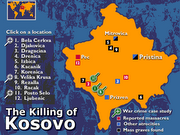
Camp Bondsteel [CBS] is quite large: 955 acres or 360,000 square meters. If you were to run the outer perimeter, it is about 7 miles. Bondsteel is located on rollinghills and farmland near the city of Ferizaj/Urosevac
It's not just a camp.


Camp Bondsteel Pictures:

Camp Bondsteel and America’s plans to control Caspian oil

Camp Bondsteel and America’s plans to control Caspian oil
(1)
Camp Bondsteel
The United States agreed to provide a force of approximately 7,000 US personnel as part of the NATO KFOR to help maintain a capable military force in Kosovo
and to ensure the safe return of Kosovar refugees. The US supports KFOR by providing the headquarters and troops for one of the four NATO sectors. The US
also provides personnel, units and equipment to other components of the KFOR organization.
Camp Bondsteel [CBS] is quite large: 955 acres or 360,000 square meters. If you were to run the outer perimeter, it is about 7 miles. Bondsteel is located on rolling
hills and farmland near the city of Ferizaj/Urosevac. There are two dining facilities at Camp Bondsteel: one in North town and one in South town. The food is very
well prepared and there are always a variety of main and side dishes to choose from. There are also salad bars, potato bars and multiple dessert offerings. Due to
General Order #1, only alcohol-free beer is served, but it is better than nothing! There are set hours for meals, but each dining facility also has a 24-hour section for
sandwiches, coffee, fruit, and continental breakfast items.
Soldiers live in SEA (Southeast Asia) Huts. There are about 250 SEA Huts for living quarters and offices. The buildings have five living areas that house up to six
soldiers each. Each building has one large bathroom with multiple shower and bathroom stalls. A few buildings have smaller bathroom facilities as well. Female and
male sea huts are separate. The beds are comfortable and each room has its own heating/air conditioning unit. Soldiers get their own wall-locker for personal storage,
and most opt to purchase a small set of plastic bins for additional storage. You can buy almost anything from the PX to make your living space more comfortable,
such as TVs, DVD players, coffee makers and sound systems. Rooms are routinely inspected to make sure they adhere to fire and safety codes. The best way to
improve the safety of your room is to purchase an approved surge protector for European voltage, and plug all of your lights and equipment into that. Adaptors are
also available so you can plug your 220-compatible devices, like laptops, into the European outlets.
The Bondsteel PX offers soldiers the latest CDs, DVDs, electronics, souvenirs, clothing, uniforms and everything to make your stay in Kosovo comfortable. With
two stories of merchandise, the PX draws lots of multinational soldiers from throughout Kosovo. Also located at CBS are Burger King, Anthony’s Pizza and a
Cappuccino bar.
There are Morale Welfare and Recreation (MWR) buildings in North town and South town. The facilities offer billiards, ping-pong, video games, interenet access
and a video teleconference room. They also offer movies to check out and watch on several TVs in the MWR facilities. There are a total of three gyms at CBS. Two
gyms (north and south) have basketball/volleyball courts, exercise equipment, weight machines and free weights. The third gym is strictly a weight room.
There are two chapels on Bondsteel, North and South, and one on Camp Monteith. All Chapels offer services in several denominations. The Laura Bush education
center offers a variety of college courses to suit your needs. Want to learn Albanian, Serbian, or German? Improve your computer skills? The variety of college credit
and certificate courses is staggering. There are two colleges represented at US base camps: the University of Maryland and Chicago University. For those with easy
access to the Internet, online courses are offered too.
The US sector is in southeast Kosovo. Headquarters for US forces is located at Camp Bondsteel, built on 750 acres of former farmland near Urosevic. Bondsteel
has about a 6-mile perimeter. The 1,000-acre camp was built from the ground up on a former field. Basecamps Bondsteel and Monteith were established in June
1999 in Kosovo to be used as staging points for the bulk of US forces stationed in the Multi National Brigade-East. About 4,000 US service members were
stationed at Camp Bondsteel in the farm fields near Urosevac, and another 2,000 were at Camp Montieth, near Gnjilane. Both camps are named after medal of
honor recipients, Army Staff Sgt. James L. Bondsteel, honored for heroism in Vietnam, and Army 1st Lt. Jimmie W. Montieth Jr, honored for heroism in France
during World War II. Camp Able Sentry, located near the Skopje Airport, Macedonia, serves as a point of entry for supplies and personnel into Kosovo. Another
500 Americans support the operation from Camp Able Sentry in the Former Yugoslav Republic of Macedonia. The US contingent is known as Task Force Falcon.
There are a number of locations within Kosovo, other than the base camps, at which US soldiers maintain a presence.
US forces entered Kosovo in June 1999 following NATO Operation Allied Force. Since then, military officials worked to rapidly improve service members' quality
of life. At the outset, planners wanted to use the lessons learned in Bosnia and convinced decision makers to reach base-camp “end state” as quickly as possible.
Because of uncertainty about the Bosnian mission’s duration, when the Army moved across the Sava River into Bosnia in 1995, soldiers were housed first in tents –
in the winter! Only years later were they moved to semipermanent Southeast Asia (SEA) huts (a theater-of-operations design that first made its debut in Vietnam) on
base camps. Engineer planners knew it was much more cost effective to forego this gradual approach in Kosovo in favor of building end-state SEA huts right away,
and operational commanders agreed with this approach.
In contrast to the Bosnia peacekeeping mission where troops lived in tents for many months before moving into hardened structures, DoD decided to erect the
SEAhuts from the start. The single-story SEAhut wooden structures were first used in Southeast Asia and then in Bosnia. The military redesigned the SEAhuts
specifically for Kosovo. Each wooden structure has a male and a female latrine and six rooms housing six service members each. The huts have heat, hot water, air
conditioning, plumbing, electricity and telephones.
Effective force protection is critical for Camp Bondsteel, which is situated on a series of rolling hills with nearby woods on several boundaries. After the 9th Engineer
Battalion (Mechanized) used its armored combat earthmovers to create a hasty perimeter, the 94th ECB(H) and Brown & Root Services Corporation jointly
completed a 2.5-meter-high earthen berm around the entire perimeter. They removed trees to allow sufficient fields of fire and built nine wooden guard towers around
the perimeter. Due to soil, pests, and line-of-sight requirements, the battalion modified the towers by placing each on a concrete pad and adding safer and more
accessible entrance ladders. Five of the nine towers were placed on two MILVANS welded together to allow greater visibility. The added elevation enables soldiers
to view the area from 18 feet aboveground rather than from the usual eight feet.
Because of the topography and population of the camp, it eventually had two independently serviced life-support areas, with semipermanent wooden buildings known
as Davidson-style Southeast Asian huts (SEA huts) (see article). The battalion also created SOCCE huts (modified for the Special Operations Command and
Control Element) and officer/senior noncommissioned officer SEA huts that have 10 rooms with separate latrine facilities for each pair of rooms.
The 94th ECB(H) created Camp Bondsteel's road system, which was critical to alleviate blinding dust storms and enable mobility when torrential rains made the clay
soil impassable. They built the hardstand for the camp's hospital, created the road to the military and civilian materials yard, and laid a double-base surface of bitumen
on the camp's eastern access road. The battalion upgraded the main briefing room and other areas throughout Task Force Falcon's command center. It also created a
storage system for confiscated weapons and built floors for 200 tents, so soldiers would be out of the mud while SEA huts were being constructed.
To create life-support areas, the 94th ECB(H) transformed the topography of Camp Bondsteel to maximize use of the ground. The primary earthmoving mission,
dubbed Operation Wolverine Mountain after the battalion's mascot, required that more than 150,000 cubic meters of earth be moved and redistributed. That is
equivalent to the area of one football field that is 100 feet deep. To save time, the battalion lowered the two major hills in Camp Bondsteel and simultaneously filled
the large ravine between them. Combining the efforts of all four organic companies, the battalion worked two shifts totaling 20 hours per day. At times twelve 621B
scrapers, eight D7G dozers, three 130G graders, and six vibratory and sheepsfoot compactors operated on the hills. In 30 days, the battalion widened the life-
support areas, created areas for the camp's wash rack and more than half of the camp's motor pools, and built a foundation for the northern access road.
Simultaneously, the battalion created the hardstand for the American logistical supply support activity. This 600- by 160-meter area, which required 70,000 cubic
meters of earthen cut-and-fill operations, will eventually include a chapel, a morale and welfare tent, the Army and Air Force Exchange Service, and a barbershop.
Equipment and operators from nine Wolverine platoons worked around the clock to complete the project.
Shortly after site preparation began at Camp Bondsteel, a 36-inch natural-gas pipeline was discovered under the camp – right where we wanted to make a 3-foot
cut! It was easier to redesign the camp around the pipeline than dig it out, and that’s why today a “no-construction” strip of land runs northwest to southeast among
the SEA huts. The total absence of civilian sewage-treatment facilities in Kosovo forced early diversion of critical horizontal equipment to build sewage lagoons. This
project is environmentally critical since there were no sewage-treatment plants in Kosovo, and local people (including those serving military units) emptied raw
sewage into streams. The lagoon is a technically challenging mission that requires all four of the 200- by 300-meter areas to have depth deviations from final design
grade of no more than 3 inches. Led by the 535th and 568th Engineer Companies (CSE), the first area completed has a maximum deviation of only two inches across
its entire 60,000-square-meter area.
Camp Bondsteel has an improved detention facility, with a 250 by 350 foot temporary structure composed of tents with plywood sidewalls and floors, electricity,
heat, and lights. The project also includes a separate shower point and security measures - perimeter fencing, triple-standard concertina wire, locking gates, and an
upgraded guard tower. The facility replaced an interim holding cell at Bondsteel and provides space for persons detained in incidents throughout the US sector in
Kosovo.
In August 1999 the 9th Combat Engineer Battalion (Mechanized) at Camp Bondsteel altered the southwest perimeter at Camp Bondsteel to make room for the new
helicopter landing zone. Engineers reworked triple-standard concertina wire to pull it out farther from the area targeted for landings. To make this change to the
perimeter, engineers first had to cut down several trees both to make room and to afford proper line of sight from the guard tower. They worked with Civil Affairs to
coordinate the tree removal with local villagers whose property adjoins the area.
In August 1999 the helicopter landing area used since Camp Bondsteel opened moved from the command operations area to a site on the post's south perimeter.
Five new helipads made of AM2 aluminum matting handled helicopter landings for a few months until an expanded aviation area was completed with 52 helipads. The
94th Engineer Battalion also completed separate areas for landing sling loads and Chinooks (CH47s). The vacated landing site allowed engineers to expand the main
access road and prepare the ground for erecting four clamshells, which are temporary frame-and-fabric structures. The plan was to transition all aircraft from Camp
Able Sentry, Macedonia, to Camp Bondsteel as a home base.
http://www.globalsecurity.org/military/facility/camp-bondsteel.htm
(2)
Camp Bondsteel and America’s plans to control Caspian oil
By Paul Stuart29 April 2002
Camp Bondsteel, the biggest “from scratch” foreign US military base since the Vietnam War is near completion in the Yugoslav province of Kosovo. It is located
close to vital oil pipelines and energy corridors presently under construction, such as the US sponsored Trans-Balkan oil pipeline. As a result defence contractors—in
particular Halliburton Oil subsidiary Brown & Root Services—are making a fortune.
In June 1999, in the immediate aftermath of the bombing of Yugoslavia, US forces seized 1,000 acres of farmland in southeast Kosovo at Uresevic, near the
Macedonian border, and began the construction of a camp.
Camp Bondsteel is known as the “grand dame” in a network of US bases running both sides of the border between Kosovo and Macedonia. In less than three years
it has been transformed from an encampment of tents to a self sufficient, high tech base-camp housing nearly 7,000 troops—three quarters of all the US troops
stationed in Kosovo.
There are 25 kilometres of roads and over 300 buildings at Camp Bondsteel, surrounded by 14 kilometres of earth and concrete barriers, 84 kilometres of
concertina wire and 11 watch towers. It is so big that it has downtown, midtown and uptown districts, retail outlets, 24-hour sports halls, a chapel, library and the
best-equipped hospital anywhere in Europe. At present there are 55 Black Hawk and Apache helicopters based at Bondsteel and although it has no aircraft landing
strip the location was chosen for its capacity to expand. There are suggestions that it could replace the US airforce base at Aviano in Italy.
According to Colonel Robert L. McClure, writing in the engineers professional Bulletin, “Engineer planning for operations in Kosovo began months before the first
bomb was dropped. At the outset, planners wanted to use the lessons learned in Bosnia and convinced decision makers to reach base-camp ‘end state’ as quickly as
possible.”
Initially US military engineers took control of 320 kilometres of roads and 75 bridges in the surrounding area for military use and laid out a base camp template
involving soldiers living quarters, helicopter flight paths, ammunition holding areas and so on.
McClure explains how the Engineer Brigade were instructed “to merge construction assets and integrate them with the contractor, Brown & Root Services
Corporation, to build not one but two base camps [the other is Camp Monteith] for a total of 7,000 troops.”
According to McClure, “At the height of the effort, about 1,000 former US military personnel, hired by Brown & Root, along with more than 7,000 Albanian local
nationals, joined the 1,700 military engineers. From early July and into October [1999], construction at both camps continued 24 hours a day, seven days a week.”
Brown & Root Services provides all the support services to Camp Bondsteel. This includes 600,000 gallons of water per-day, enough electricity to supply a city of
25,000 and a supply centre with 14,000 product lines. It washes 1,200 bags of laundry, supplies 18,000 meals per day and operates 95 percent of the rail and
airfield facilities. It also provides the camps firefighting service. Brown & Root are now the largest employers in Kosovo, with more than 5,000 local Kosovan
Albanians and another 15,000 on its books.
Staff at Camp Bondsteel rarely venture outside the compound and their activities are secretive. Whilst other KFOR patrols are small and mobile with soldiers wearing
soft caps and instructed to integrate with the local population, US military personnel leave Bondsteel in either helicopters or as part of infrequent but large heavily
armed convoys.
In unnamed interviews US troops complain that hostility to their presence is growing as local inhabitants compare the investment in Camp Bondsteel with the
continuing decline in their own living standards.
Those visiting Camp Bondsteel describe it as a journey through 100 years in time. The area surrounding the camp is extremely poor with an unemployment rate of 80
percent. Then Bondsteel appears on the horizon with its mass of communication satellites, antennae and menacing attack helicopters circling above. Brown & Root
pay Kosova workers between $1 and $3 per hour. The local manager said wages were so low because, “We can’t inflate the wages because we don’t want to over
inflate the local economy.”
The escalating US presence at Bondsteel was accompanied by increased activity by the Kosovo Liberation Army (KLA). Since its appearance most Serbs, Roma
and Albanians opposed to the KLA have been murdered or driven out. Those remaining dare not leave their houses to buy food at the local stores and the need for
military escorts stretch from children’s swimming pools to tractors taken away for repair. According to observers the KLA continue to act with virtual impunity in the
US sector despite the high tech military intelligence facilities at Bondsteel.
When US troops arrive at Camp Bondsteel, they are more likely to be met by a Brown & Root employee directing them to their accommodation and equipment
areas. According to G. Cahlink in Government Executive Magazine (February 2002), “Army peace keepers joke that they’re missing a patch on their camouflage
fatigues. ‘We need one that says Sponsored by Brown & Root,’ says a staff sergeant, who, like more than nearly 10,000 soldiers in the region, has come to rely on
Brown and Root Services, a Houston based contractor, for everything from breakfast to spare parts for armoured Humvees.”
The contract to service Camp Bondsteel is the latest in a string of military contracts awarded to Brown & Root Services. Its fortunes have grown as US militarism has
escalated. The company is part of the Halliburton Corporation, the largest supplier of products and services to the oil industry.
In 1992 Dick Cheney, as Secretary of Defence in the senior Bush administration, awarded the company a contract providing support for the US army’s global
operations. Cheney left politics and joined Halliburton as CEO between 1995 and 2000. He is now US vice president in the junior Bush administration. In 1992
Brown & Root built and maintained US army bases in Somalia earning $62 million. In 1994 Brown & Root built bases and support systems for 18,000 troops in
Haiti doubling its earnings to $133 million. The company received a five-year support contract in 1999 worth $180 million per-year to build military facilities in
Hungary, Croatia and Bosnia. It was Camp Bondsteel, however, that was dubbed “the mother of all contracts” by the Washington based Contract Services
Association of America. There, “We do everything that does not require us to carry a gun,” said Brown & Roots director David Capouya.
The aim of outsourcing military support and services to private contractors has been to free up more soldiers for combat duties. A US Department of Defence (DoD)
review in 2001 insisted that the use of contractors would escalate: “Only those functions that must be done at DoD should be kept at DoD.”
In sectors controlled by other Western powers, KFOR soldiers who are living in bombed out apartment blocks and old factories joke, “What are the two things that
can be seen from space? One is the Great Wall of China, the other is Camp Bondsteel.”
More seriously a senior British military officer told the Washington Post, “It is an obvious sign that the Americans are making a major commitment to the Balkan
region and plan to stay.” One analyst described the US as having taken advantage of favourable circumstances to create a base that would be large enough to
accommodate future military plans.
Camp Bondsteel has become a key venue for important policy speeches by leading officials of the Bush administration.
On June 5, 2001 US Secretary of Defence Donald Rumsfeld explained to troops at Camp Bondsteel what role they played in the new administration’s economic
strategy. He declared, “How much should we spend on the armed services? ...My view is we don’t spend on you, we invest in you. The men and women in the
armed services are not a drain on our economic strength. Indeed you safeguard it. You’re not a burden on our economy, you are the critical foundation for growth.”
One month later, President George W. Bush made his first trip abroad to see US troops at the camp. He traveled directly from the Rome G8 summit, where tensions
with European governments had come to the fore. In a speech described as a “retrenching” of the US in Europe, he insisted that US troops were in Kosovo to stay,
had gone in together and would “leave together”. In a break from normal procedure, in front of cheering troops, Bush signed into law a Congress-approved increase
in military spending of $1.9 billion.
Since then Camp Bondsteel has continued to grow, as it spearheads the first phase in a realignment of US military bases in Europe and eastward. The Bondsteel
template is now being applied in Afghanistan and the new bases in the former Soviet Republics.
According to leaked comments to the press, European politicians now believe that the US used the bombing of Yugoslavia specifically in order to establish Camp
Bondsteel. Before the start of the NATO bombing of Yugoslavia in 1999, the Washington Post insisted, “With the Middle-East increasingly fragile, we will need
bases and fly over rights in the Balkans to protect Caspian Sea oil.”
The scale of US oil corporations investment in the exploitation of Caspian oil fields and the US government demand for the economy to be less dependent on
imported oil, particularly from the Middle-East, demands a long term solution to the transportation of oil to European and US markets. The US Trade &
Development Agency (TDA) has financed initial feasibility studies, with large grants, and more recently advanced technical studies for the New York based AMBO
(Albania, Macedonia, Bulgaria Oil) Trans-Balkan pipeline.
Announcing a grant for an advanced technical study in 1999 for the AMBO oil pipeline through Bulgaria, Macedonia and Albania, TDA director J. Joseph
Grandmaison declared, “The competition is fierce to tap energy resources in the Caspian region....Over the last year [1999], TDA has been actively promoting the
development of multiple pipelines to connect these vast resources with Western markets. This grant represents a significant step forward for this policy and for US
business interests in the Caspian region.”
The $1.3 billion trans-Balkan AMBO pipeline is one of the most important of these multiple pipelines. It will pump oil from the tankers that bring it across the Black
Sea to the Bulgarian oil terminus at Burgas, through Macedonia to the Albanian Adriatic port of Vlore. From there it will be pumped on to huge 300,000 ton tankers
and sent on to Europe and the US, bypassing the Bosphorus Straits—the congested and only route out of the Black Sea where tankers are restricted to 150,000
tons.
The initial feasibility study for AMBO was conducted in 1995 by none other than Brown & Root, as was an updated feasibility study in 1999. In another twist, the
former director of Oil & Gas Development for Europe and Africa for Brown & Root Energy Services, Ted Ferguson, was appointed as the new president of AMBO
[1997] after the death of former president and founder of AMBO, Macedonian born Mr Vuko Tashkovikj.
According to a recent Reuters article, Ferguson declared that Exxon-Mobil and Chevron, two of the worlds largest oil corporations, are preparing to finance the
AMBO project.
The building of AMBO risks antagonising Turkey, the US’s main ally in the region. According to the Reagan Information Interchange, “While the United States is
making an advantageous economic decision, it is overlooking its crucial strategic relationship with Turkey.”
The US is also antagonising its European allies and Russia with Camp Bondsteel and other smaller military bases run alongside the proposed AMBO pipeline route. It
has been built near the mouth of the Presevo valley and energy Corridor 8, which the European Union has sponsored since 1994 and regards as a strategic route
east-west for global trade.
In April 1999, British General Michael Jackson, the commander in Macedonia during the NATO bombing of Serbia, explained to the Italian paper Sole 24 Ore
“Today, the circumstances which we have created here have changed. Today, it is absolutely necessary to guarantee the stability of Macedonia and its entry into
NATO. But we will certainly remain here a long time so that we can also guarantee the security of the energy corridors which traverse this country.”
The newspaper added, “It is clear that Jackson is referring to the 8th corridor, the East-West axis which ought to be combined to the pipeline bringing energy
resources from Central Asia to terminals in the Black Sea and in the Adriatic, connecting Europe with Central Asia. That explains why the great and medium sized
powers, and first of all Russia, don’t want to be excluded from the settling of scores that will take place over the next few months in the Balkans.”
source: wsws

Abkhazia does not need to use Kosovo as a precedent for its own claim for independence

March 13, 2008, 20:39
Abkhazia does not need to use Kosovo as a precedent for its own claim for independence,
the Abkhazian president Sergey Bagapsh has said. "This was because the
unrecognised republic has always had its own statehood both within the Russian Empire and later the Soviet Union".
He added his people have historically relied on and are committed to Russia.
“We are a small but self-sufficient country today. Big countries merge into unions and alliances. Abkhazia is no exception here, it might join in union with Russia. Our
hopes are on Russia, and it’s not only the position of the leadership but of the people,” he said.

U.N. tells Serbia to quit interfering in Kosovo
By Matt RobinsonWed Mar 12, 8:53 AM ET
U.N. authorities in Kosovo told Serbia on Wednesday to stop interfering in Serb areas of the new state, where a Serb boycott has fuelled speculation Belgrade is
trying to partition the territory.
The U.N. mission called on Serbia to respect its mandate in the former Serbian province, where the 90-percent Albanian majority declared independence with
Western-backing last month.
It said Serbia should cooperate in re-establishing customs points on Kosovo's northern border, which were burned down by Serb mobs, allow Serb police officers to
return to work and stop strengthening Belgrade-financed "parallel structures" in health, education, courts and administration.
"If Belgrade says publicly that (U.N. Security Council Resolution) 1244 should be respected, we expect them to put their money where their mouth is," U.N. mission
spokesman Alexander Ivanko told a news conference.
"We are trying to re-establish the courts, we are trying to re-establish the customs," he said. "This will take time, it will not happen tomorrow."
Kosovo declared independence on Feb 17, nine years after NATO bombed to drive out Serbian forces and halt the killing and ethnic cleansing of Albanians in a
two-year Serbian counter-insurgency war.
Backed by big-power ally Russia, Serbia has rejected the secession and is instructing the 120,000 remaining Serbs to do the same, deepening an ethnic divide that
almost nine years of international administration since the war has failed to tackle.
NO FORCE
Hundreds of Serb officers in the Kosovo police have been suspended after refusing to take orders from the Albanian-dominated command.
The Serb stronghold of north Kosovo is bidding to take control of the main U.N. court in the area, blocking its Albanian staff from traveling to work, and has also
claimed control over the railway line running up to Serbia.
NATO troops now secure the two main border points in the north after they were torched by Serbs followed Kosovo's declaration and U.N. and Kosovo police
pulled out. The U.N. has yet to re-establish customs points.
A 2,000-strong European Union law and order mission is taking over much of the role of the U.N. mission, under the authority of International Civilian Representative
Pieter Feith.
The Dutch diplomat has accused Serbia of trying to sever ties between Kosovo's Albanian majority and minority Serbs, in a strategy he said bordered on partition.
In a newspaper interview on Wednesday, Feith said it could take years for the mission's presence to be fully accepted in the north, where an advance EU staff has
already pulled out over security fears.
"There are two things we certainly won't do," he told the Belgrade daily Vecernje Novosti. "We won't use force or start World War Three in order to deploy our
mission."
(Additional reporting by Ellie Tzortzi; editing by Philippa Fletcher)

Moscow Warns NATO on Georgia

Moscow warns Nato on Georgia
Rogozin said beginning Georgia's accession to Nato would be a 'very dangerous process' [EPA]
Georgia's separatist regions of Abkhazia and South Ossetia are likely to break away if Nato seeks closer ties with Tbilisi, Russia's ambassador to the military alliance
has warned. Dmitry Rogozin said: "In the case of any invitation to Georgia on the part of Nato, driven by the US, we can expect the separation of Abkhazia and South Ossetia."
Abkhazia and South Ossetia split from Georgia in conflicts in the early 1990s in which thousands of people were killed and hundreds of thousands of ethnic-
Georgians were forced to leave their homes. Most of their population hold Russian passports and both territories are funded by Moscow. 'Dangerous process' The regions have called for international recognition of their self-declared independence, citing Kosovo's decision last month to break away from Serbia as a
precedent.Rogozin underlined that a national referendum on whether to join Nato organised in December by Mikheil Saakashvili, Georgia's president, was not held in its two
breakaway republics.
The ambassador said on Tuesday: "This is why I think that if Nato accepts that Georgia takes part in the Membership Action Plan (Map), that this could provoke the
secession of the two territories.
"This would be enough for the separatists to go through with secession."
The Map programme, seen as a preliminary to Nato membership, helps aspiring countries meet alliance standards and prepares them to join.
Rogozin said: "It is a very dangerous process because it could reheat the conflict. All this is of concern to us, because it's happening near our borders.
"Many citizens of the northern Caucasus have links with South Ossetia and Abkhazia."
'Blackmail'
Elene Khoshtaria, Georgia's deputy minister for European and Euro-Atlantic integration, said that Russia was trying to blackmail Georgia into not joining Nato.
She said: "The statement... is nothing but an attempt to blackmail allied nations and Georgia. Georgia's Nato membership bid is not against Russia, it's about our
dedication to the common values of democratic nations.
"I am confident that Nato member states will make a decision on Georgia's membership independently and that third-party blackmail cannot hamper this process."
Meanwhile, the United States said on Tuesday that it regretted Russia's decision last week to lift trade sanctions imposed on Abkhazia and reaffirmed its support for
Georgia's territorial integrity.
The Russian sanctions were imposed in 1996 as part of efforts to limit the separatist aspirations of Abkhazia.
Zalmay Khalilzad, the US ambassador to the United Nations, said: "The United States regrets Russia's decision to withdraw unilaterally from the CIS
(Commonwealth of Independent States) sanctions on Abkhazia.
"We do not see how it contributes to stability in the South Caucasus, resolution of the Abkhazian conflict or improvement of Russian-Georgian relations.
Moscow said it was lifting the trade restrictions but denied it had been influenced by Western support for Kosovo's independence.
The Russian foreign ministry said that Moscow "no longer considers itself bound by the terms" of a sanctions accord approved by the ex-Soviet CIS in 1996.
Vladimir Putin, Russia's outgoing president, has accepted an invitation to a Nato summit in Bucharest, the Romanian capital, in April.
Source: Agencies

South Ossetia:Russian, Georgian...independent?

South Ossetia: Russian, Georgian...independent?
Shaun Walker
A decisive referendum result has done nothing to resolve the small Caucasian statelet's future, reports Shaun Walker.15 - 11 - 2006
On Sunday 12 November 2006, South Ossetians went to the polls to vote in a referendum confirming the region's independence from Georgia. The result was an
overwhelming "yes" to independence, with a turnout above 95% from those among the territory's 70,000 people who were eligible to vote. There was a similar vote
in favour of a new term for South Ossetia's president, Eduard Kokoity. Neither outcome came as a surprise, but the chances are that nobody in the international
community will take the slightest bit of notice of the results.
South Ossetia is a bite-sized chunk of land on the southern slopes of the Caucasus mountains, one of four "breakaway states" that - along with fifteen recognised
nation-states - emerged from the collapse of the Soviet Union (the other three are Abkhazia, Transdniestria, and Nagorno-Karabakh). The Ossetians are a largely
Christian people, whose language is related to Farsi, and the majority of whom live on the northern side of the Caucasus in North Ossetia, which is part of Russia.
South Ossetia was part of the Georgian republic within the Soviet Union, but in the early 1990s tried to gain autonomy from Tbilisi, which led to violent clashes in
which many died and thousands were made refugees, both Georgian and Ossetian.
Since then, South Ossetia, with the exception of a few villages controlled by the Georgian government in Tbilisi, has been run as a de facto independent state,
although its proclamations of independence have been ignored by the international community. The territory is heavily reliant on Russian support. As in Abkhazia,
Moscow has infuriated the Georgians by granting passports to the majority of the South Ossetian population, and providing significant economic backing. Shaun
Walker is a journalist based in Moscow, where he writes for RussiaProfile.org
Also by Shaun Walker in openDemocracy:
"Anna Politkovskaya: death of a professional" (9 October 2006) A state of limbo
The United States, the European Union, the Organisation for Security and Cooperation in Europe (OSCE) and Nato all issued statements before the 12 November
vote that branded the referendum meaningless and unhelpful. Georgia repeatedly derided it as illegitimate, though it had no problems with backing an "alternative"
election and referendum that took place in the villages that Tbilisi controls. Even Russia's quiet endorsement of the result has stopped short of official recognition.
The authorities in South Ossetia's capital, Tskhinvali, managed to gather some "international monitors" to oversee the voting, largely from members of other
breakaway states but including Russians, Venezuelans, and a few renegade European communists. Few foreign correspondents turned up to cover the events, and the
chances are that the results will be forgotten as quickly as those of the referendum held in Transdniestria, Moldova's breakaway statelet, on 17 September.
When the dust has settled on the ballot-boxes, everyone will be back to square one. Russia is highly unlikely to recognise South Ossetian independence or initiate
procedures to facilitate the accession of the region to the Russian Federation. But equally, it is likely to continue antagonising Georgia through informal support for
South Ossetia. The lastest example of this came days before the referendum when Moscow followed its announcement of sharp increases in gas prices for Georgia
proper by declaring that a gas pipeline would be built directly across the Caucasus mountains to South Ossetia. President Putin has hinted that he sees no reason why
South Ossetians and Abkhaz shouldn't be granted independence if Kosovo and Montenegro can be.
There is certainly an element of cynical politicking behind Russia's South Ossetia policy. Georgia is public-enemy-number-one in Moscow right now, and meddling in
the breakaway zones is a sure-fire way to annoy Tbilisi. But aside from the Russians installed into high positions in the South Ossetian leadership, and the giant "our
president" posters featuring a grinning Putin dotted around Tskhinvali, any visitor to South Ossetia will notice significant ground-level pro-Russian sentiment, or at least
an appreciation of the possibilities that being close to Russia offers them.
A Russian passport is akin to a lifeline for South Ossetians - a way to get an education or a job in North Ossetia or Moscow. There are very few jobs in the region,
so most families have at least one person working in Russia and sending money home. It becomes obvious when talking to people that reintegration into the Georgian
state will not be an easy process - to start with, only the eldest generation even speaks the language. People would not be able to get jobs or study in Tbilisi - Russia
provides them with their only chance to make something of their lives.
Moreover, aggressive statements from Tbilisi setting deadlines for the recovery of the territory, and military construction of a base in Gori (just twenty-five kilometres
from the South Ossetian capital), do nothing to reassure the South Ossetians. With a highly militarised population, and a lack of crisis-management mechanisms, there
is always the chance that localised incidents or skirmishes could escalate into something that quickly gets out of control. Also in openDemocracy on Caucasian
fractures :
Alexander Rondeli, "Georgia: a rough road from the rose revolution" (4 December 2003 )
Neal Ascherson, "Tbilisi, Georgia: the rose revolution’s rocky road" (15 July 2005)
Thomas de Waal & Zeyno Baran, "Abkhazia-Georgia, Kosovo-Serbia: parallel worlds?" (2 August 2006)
Donald Rayfield, "Georgia and Russia: with you, without you" (3 October 2006)
Robert Parsons, "Russia and Georgia: a lover's revenge"(6 October 2006)
George Hewitt, "Abkhazia: land in limbo" (10 October 2006)A landlocked predicament
There is some irony in the fact that the South Ossetian and Georgian outlooks share similarites. Both see a much larger and aggressive neighbour (Russia for Georgia,
Georgia for South Ossetia), and thus feel forced to seek comfort in third countries in ways that might not serve their interests best in the long run (the United States for
Georgia, Russia for South Ossetia). Just looking at the map makes it obvious that it would be in Georgia's best interests to find a way to coexist peacefully with
Russia, and in South Ossetia's to do the same with Georgia.
The South Ossetian leadership, despite having legitimate grievances against the Georgians, is mired in suspicion and introspection, making endless statements about
"provocations" and "conspiracies" from the Georgian side, but reluctant to let in people (such as foreign journalists, regional analysts and constitutional experts) to
whom they could put their side of the story.
The Georgians have their public relations a little better organised. When Mikheil Saakashvili's young, western-educated government came to power in Tbilisi in the
"rose revolution" of 2003-04, it quickly understood that the best way to get the west onside would be to speak to it in a language it understands; there followed
copious worthy pronouncements about freedom, human rights, and the path of the courageous Georgian people to be free from the jealous paws of the post-imperial
Russian bear. Amid the rhetoric, Tbilisi made it abundantly clear that one of the key markers of its success would be the restoration of Georgia's territorial integrity.
But "territorial integrity", when examined closely, is as nebulous a concept as "fighting terror": open to many convenient interpretations. The breakaway states
(including South Ossetia) are ready to cite Kosovo as a precedent if that territory is recognised as an independent state. This was not possible in the case of
Montenegro's independence from Serbia (sanctioned by the referendum on 21 May 2006, and agreed to by the Serbian government in Belgrade), but Kosovo's
claim to independence (which Serbia strenuously objects to, citing numerous legal objections) offers the opportunity for Tskhinvali to demand the same right.
At the same time, the arbitrary borderlines of some of the constituent republics within the Soviet Union (which its successor states inherited) often do not translate
easily into a basis for modern statehood. Indeed, in many cases the communist elite explicitly drew frontiers for "divide and rule" reasons. In sum, the contested and
imprecise idea of territorial integrity can still be used by the Georgians (with international support) in their efforts to recover South Ossetia, while the South Ossetians
can invoke the concept's flaws to argue that their right of self-determination should override it.
In the case of Abkhazia, many experts and even some western diplomats privately admit that it may never be part of Georgia again. But South Ossetia is a different
story. Abkhazia has a strategic coastline providing an outlet to the world beyond Russia and Georgia, as well as vast tourism potential. Even sliver-thin Transdniestria
has a Soviet-era industrial complex that provides jobs and revenues. South Ossetia has nothing. It combines a small population with no industrial infrastructure, no sea
access and only one road that leads anywhere except Georgia. It also has a number of ethnic Georgian villages scattered across its territory that are under the control
of the Georgian government in Tbilisi.
In short, South Ossetia is unviable as a fully independent state. This makes South Ossetia a zero-sum game between Georgia and Russia. in turn, it means that South
Ossetian separation from Georgia is a much more worrying prospect for western policymakers than Abkhazian.
Between north and south
The removal on 10 November of bellicose Georgian defence minister Irakli Okruashvili (who was born in South Ossetia and has frequently implied that South Ossetia
could be won back by force) may be a sign that Georgia intends to adopt a more tactful approach to the conflict. The timing is symbolic on more than one count;
perhaps the Georgians had one eye on Washington, where a far more powerful defence secretary had left office two days earlier.
The recent crisis between Georgia and Russia has proved what should have been obvious to them all along - that while Tbilisi can rely on kind words and lobbying
from the United States when it comes up against Russia, they can't rely on anything more. And with the US election on 7 November delivering a crushing blow to the
George W Bush administration, perhaps Saakashvili has also started to wonder if the next occupant of the White House will buy his freedom-and-democracy lines as
much as Bush has.
Indeed, this might signal the start of a more sensible South Ossetia policy from the Georgian side. It is clear that mutual suspicion runs high, and the reintegration into
Georgia of a people who have lost linguistic and cultural ties with that country will not be an easy process. Without war, wholesale destruction and ethnic cleansing,
Tbilisi won't win control of South Ossetia any time soon.
At present, no attempts are being made to engage the people of South Ossetia or suggest that Georgia has anything to offer. The Georgians should focus on
rebuilding Georgia proper and ensuring continued economic growth, and to reach past the obstructive South Ossetian leadership to prove to the Ossetian people that
a newly prosperous and tolerant Georgia is a better option than Russia's troubled north Caucasus. It won't happen quickly. But even though 99% of South Ossetians
have just voted for independence, a Tbilisi that plays down the aggressive precondition that South Ossetia must be part of Georgia might just - in a very Caucasian
paradox - become the catalyst for its eventual reintegration into that country.